


Description
PrymaLab · Research Use Only
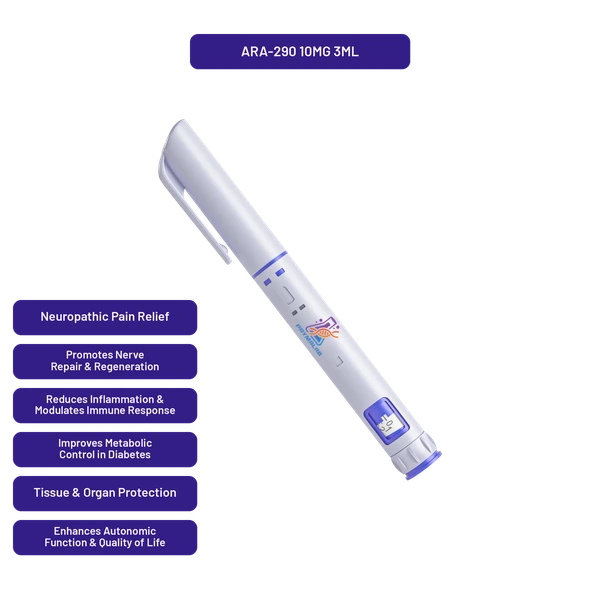
Preloaded Autoinjector | ARA-290 (Cibinetide) | 3ml Pen | 10mg
Eleven-residue EPO-derived peptide in solution · 3ml at 10/3 mg/ml · No reconstitution step
The ara 290 pen is a preloaded 3ml research autoinjector holding cibinetide in solution at 10/3 mg/ml, giving 10mg of the 11-residue erythropoietin-derived peptide per device. The molecule contains no sulfur and no aromatic residue at all, so oxidation is close to irrelevant and a single asparagine at position 9 carries almost the whole degradation risk.
Specification Table
| Property | Value |
|---|---|
| Device format | Preloaded autoinjector pen, glass cartridge |
| Fill volume | 3 ml |
| Concentration | 10/3 mg/ml |
| Total compound in device | 10 mg |
| Molar concentration | 0.265 × 10 mM (265 × 10 µM) |
| Compound | Cibinetide (development code ARA-290), an 11-residue peptide corresponding to a surface region of helix B of erythropoietin |
| CAS number | 1208243-50-8 |
| Molecular formula | C51H84N16O21 |
| Molecular weight | 1257.32 g/mol (average) |
| Amino acid sequence | pyroGlu-Glu-Gln-Leu-Glu-Arg-Ala-Leu-Asn-Ser-Ser, written (pE)EQLERALNSS, free-acid C-terminus |
| N-terminal modification | Pyroglutamate. The N-terminal glutamate is cyclised to a lactam, which caps the chain |
| Deamidation site | Asn9, in an Asn-Ser motif, the principal chemical liability in solution |
| Solution appearance | Not published on the product record. An intact solution is clear and colourless |
| Reconstitution required | None. Supplied as solution |
| Excipient system | Not published on the product record. Confirm against certificate of analysis |
| Solution pH | Not published on the product record. Mildly acidic to neutral limits deamidation |
| Storage | 2-8°C, protected from light. Do not freeze |
| Light sensitivity | Low. No Trp, Tyr, Phe, Cys, Met or His, so photo-oxidation is minimal. Protection is precautionary |
| Solution stability | Not established over device shelf life. No public forced-degradation study was located |
| Plasma half-life | On the order of minutes, approximately 2 minutes as widely reported |
| Salt form | Not published on the product record. Research material is typically acetate or trifluoroacetate |
| Purity | Per lot-specific certificate of analysis |
| Regulatory status | No approved product in any jurisdiction. Investigational (Araim Pharmaceuticals); no phase 3 efficacy trial reported |
ARA 290 Solution Stability: What Happens to Asn9 in a Filled Cartridge?
One residue carries the risk. Asn9 sits in an Asn-Ser motif, one of the faster deamidation contexts after Asn-Gly, and it converts to a mixture of aspartate and isoaspartate at a rate that rises as pH moves from mildly acidic toward alkaline.
The rest of the sequence is remarkably inert. (pE)EQLERALNSS contains no cysteine, so there is no disulfide to reduce or scramble; no methionine and no histidine, so metal-catalysed oxidation has nothing obvious to attack; and no tryptophan, tyrosine or phenylalanine, so there is no aromatic ring to photo-oxidise. Eleven residues is too short for the aggregation behaviour that dominates larger peptides, and the charge distribution, three glutamates against one arginine, makes it hydrophilic rather than surface-active. Adsorptive loss is modest, though it still matters at the low concentrations used downstream.
That leaves the deamidation, and the mass arithmetic is worth knowing before a certificate is read. Loss of the side-chain amide adds 0.98 Da, so a deamidated species appears at 1258.3 Da against the intact 1257.32 Da. High-resolution instruments resolve that; low-resolution ones frequently do not. Worse, the two products of the reaction, aspartate and isoaspartate, are isobaric with each other, so the intact mass cannot say which formed. Isoaspartate inserts an extra methylene into the backbone and changes the local conformation, which for an 11-residue peptide whose activity depends on a specific surface is a change worth distinguishing. Doing so needs a method that targets it directly, such as a peptide map with the appropriate fragmentation or a protein isoaspartyl methyltransferase assay, not a purity percentage.
The pyroglutamate at the N-terminus works in the other direction. It is a cap: the first residue is cyclised to a lactam, which blocks aminopeptidase attack and removes the free N-terminal amine. What is less often noticed is that the cyclisation can also run during storage. Synthesis that leaves some open-chain glutamate material produces a preparation whose minor component closes over time with an 18 Da mass loss, so the intact-mass profile of a stored solution can drift toward the target mass rather than away from it. A lot certificate showing a small species 18 Da above the main peak is describing incomplete cyclisation, not degradation.
No public forced-degradation study for this peptide was located, and cibinetide is investigational, so no approved formulation exists whose pH, buffer or preservative could be used as a precedent. Trials used a subcutaneous solution, which establishes that a solution presentation is workable and nothing about how one should be buffered for shelf life.
ARA 290 Half Life: Why Two Minutes Is the Argument for a Device
The reported ara 290 half life is on the order of minutes, approximately 2 minutes in plasma, which is short enough that plasma exposure is effectively a pulse and the tissue effect outlasts it because the signalling happens at sites of injury rather than in circulation.
That pharmacokinetic profile changes what consistency is worth. When a compound has a six-day half-life, a small error in delivered volume is smoothed out by accumulation across doses. When it clears in minutes, every delivery is a separate event and the variance between them is not averaged away by anything. A preloaded cartridge fixes concentration at manufacture and leaves volume as the only variable, which is the strongest argument in this compound’s favour for the format, and it is a pharmacokinetic argument rather than a convenience one.
The receptor biology is the reason the effect persists at all. Cibinetide acts at a heterocomplex of the erythropoietin receptor with the beta-common receptor subunit, CD131, which is a different assembly from the homodimeric receptor that drives red-cell production, and that separation is the design goal: Brines 2008 isolated tissue-protective activity to short helix-B-derived peptides that do not raise haematocrit. Reported trial read-outs are corneal and intra-epidermal nerve-fibre measures and neuropathic pain scores rather than anything measured in plasma.
What Does the ARA 290 Pen Deliver Per Increment?
At 10mg in 3 ml the concentration is 10/3 mg/ml and the molar concentration is 0.265 × 10 mM, so a 0.01 ml increment carries 10/300 mg, which is 3.33 × 10 micrograms, and a 0.1 ml increment carries 33.3 × 10 micrograms.
Anchoring that to the published work takes one more step. The published human work ran in the single-milligram range per administration, with Culver 2017 the most-cited arm. Set against a 3 ml cartridge, that tells a purchaser the device holds a multi-week quantity at any plausible fill, and it tells them nothing about how to divide it, because the trials were supervised clinical administrations and this is laboratory supply. Those two strengths differ by a factor of two and a half in the volume they require for the same mass, which is the reason a fixed-concentration device has to be specified by concentration and not by total content.
Two cautions attach. The graduation resolution of this specific device is not stated on the product record, and the 0.01 ml increment used above is the common insulin-pattern value rather than a confirmed property; the peptide calculator recomputes for any other graduation. And the trial figures above describe what investigators administered to participants under supervision, not a protocol of any kind for a research article.
ARA 290 Pen vs Vial: What Does the Format Suit?
The ara 290 pen vs vial choice turns on repetition: the trials dosed daily for 28 days or longer, so the format question is really whether preparation should be repeated dozens of times or performed once at manufacture.
A cartridge removes reconstitution from the sequence entirely, and for a peptide this hydrophilic the reconstitution risks are modest rather than severe, which weakens the usual argument for a device. What survives is consistency: one solution, one concentration, one lot, drawn many times. Given a two-minute half-life, that consistency is worth more here than for compounds that accumulate. The general comparison is in the pen versus vial article, and the fields to confirm before ordering any device are listed on the preloaded autoinjector category page.
The counter-argument is the deamidation clock. A dry cake does not deamidate at any rate worth measuring; a solution does, continuously, from the fill date onward, at a rate set by a pH the product record does not state. The lyophilized cibinetide vial lets the laboratory choose a mildly acidic buffer that suppresses the reaction and to prepare only what a session needs. ARA 290 solution vs lyophilized is, for this molecule, a straight trade between convenience and control of one specific chemical rate. The nasal presentation answers a third question, fixing delivered volume as well as concentration.
What the Product Record Does Not State
Four fields decide what this solution is and none is published: the pH, the excipient system, the peptide salt form, and the fill date from which the deamidation clock runs.
The pH is the one that matters most, and the reason is specific rather than general. Asn deamidation is base-catalysed through a succinimide intermediate, so the rate at pH 7.4 is materially higher than at pH 5, and the difference over a multi-week shelf life is the difference between a preparation that is nearly all intact and one that is measurably not. Without the number, the rate is unknown and no shelf-life estimate can be made from first principles.
The excipient system enters every assay the solution touches, and a preservative in a multi-draw cartridge is a formulation choice a buyer should be able to see. The salt form matters because research cibinetide is supplied as the acetate or the trifluoroacetate, and residual trifluoroacetate is not inert in cell work. The fill date sets position on a stability curve that nobody has published for this compound. All four belong in the request that goes with the lot certificate of analysis, before quantitative work rather than after an anomalous result.
Verifying the ARA 290 Pen and Confirming the Contents
Inspect the solution against a white background before each draw for haze or particulate, then accept that visual inspection is close to uninformative for this peptide, because the change that matters adds less than one dalton and produces no optical signal at all.
The analytical route has an unusual constraint at the start. With no tryptophan, tyrosine or phenylalanine in the sequence, there is no absorbance at 280 nm and no ultraviolet quantification of the standard kind. Content has to come from backbone absorbance near 214 nm against a reference standard, from charged aerosol or evaporative light-scattering detection, or from amino acid analysis. This constraint is worth knowing before a method is designed rather than after a blank result.
Deamidation is best chased by chromatography rather than by mass alone. The deamidated species is 0.98 Da heavier and usually elutes slightly differently on reversed phase, and ion-exchange separates the products by the charge the new carboxylate adds, which is often the more sensitive approach. Distinguishing aspartate from isoaspartate needs a targeted method, since the two are the same mass. A vial of the same compound reconstituted the same day gives any of these measurements a comparator, which is more useful than a literature retention time obtained on someone else’s column.
Let the device reach ambient temperature before actuating, since cold solution is more viscous and spring-driven mechanisms deliver less volume against a viscous load. Gravimetric verification once per ara 290 pen, actuating onto a tared vessel and converting by solution density, remains the cheapest check on delivered volume.
What Do the Cibinetide Clinical Trials Report?
Four small early-phase studies, all with surrogate or symptom endpoints: Heij 2012 (approximately 22 patients, sarcoidosis), Dahan 2013 (28-day subcutaneous dosing, corneal nerve-fibre density), Brines 2014 (type 2 diabetes) and Culver 2017 (approximately 64 subjects, a 4 mg daily arm).
Brines 2008 in PNAS is the foundation. It reported that tissue-protective activity could be isolated to short peptides derived from the tertiary structure of erythropoietin, separating that activity from the red-cell-stimulating action of the parent hormone, and it supported the design with rodent models of tissue injury. Everything clinical that followed rests on that separation.
Heij 2012 in Molecular Medicine was a randomised double-blind pilot in sarcoidosis patients with small-fibre neuropathy symptoms, reporting tolerability and symptom signals in about 22 patients. Dahan 2013, also in Molecular Medicine, reported improved symptoms and increased corneal nerve-fibre density after 28 days of subcutaneous dosing in sarcoidosis-associated small nerve fibre loss. Brines 2014 reported improvements in metabolic control and neuropathic symptoms in type 2 diabetes. Culver 2017 in Investigative Ophthalmology and Visual Science was the largest of them at roughly 64 subjects, reporting improved corneal nerve-fibre abundance and pain scores with a signal at 4 mg per day.
What has not been done matters as much. There is no phase 3 efficacy trial, no approved indication anywhere, no long-term efficacy or safety data, and no controlled study of any preloaded fixed-concentration device. The endpoints in the existing studies lean heavily on corneal confocal microscopy and symptom questionnaires, which are surrogates. The consistent reported finding across the programme is that haemoglobin and haematocrit did not rise, which was the design goal and distinguishes the compound from erythropoietin itself. Sample sizes are small enough that the absence of a toxicity signal is a weak statement rather than a strong one.
What Is the Safety and Regulatory Position?
Cibinetide is investigational everywhere and approved nowhere: it is not an approved product in the United States, European Union, Japan, Australia or Canada, though orphan-designation interest has been recorded for indications such as sarcoidosis neuropathy in some jurisdictions.
It is not an approved active ingredient and is not on any FDA 503A or 503B bulk-drug-substance list, so it cannot lawfully be compounded or sold for human use. For athletes the position needs stating carefully. The compound does not stimulate erythropoiesis, which is its design goal, but that does not make it a permitted substitute for anything: WADA lists no named entry for cibinetide, and as a non-approved pharmacological substance it falls under class S0, prohibited at all times. Erythropoietin-receptor agonists are a category anti-doping authorities watch closely.
No vendor solution has published identity, purity or stability data. The tolerability observed in the trials above was recorded with characterised trial material given under supervision in studies of a few dozen participants, and it says nothing about any research preparation. The sourcing guide for this compound covers what a certificate should show. The ara 290 pen is a laboratory research article and must not be given to humans or animals.
Published Literature
The entries below were each checked against a primary index before inclusion. All of them concern the molecule. Nothing has been published about the device it is supplied in.
- Brines M, Patel NSA, Villa P, et al. Proceedings of the National Academy of Sciences USA. 2008;105(31):10925-10930. DOI: 10.1073/pnas.0805594105 PMID: 18676614
- Heij L, Niesters M, Swartjes M, et al. Molecular Medicine. 2012;18(11):1430-1436. DOI: 10.2119/molmed.2012.00332 PMID: 23168581
- Dahan A, Dunne A, Swartjes M, et al. Molecular Medicine. 2013;19(1):334-345. DOI: 10.2119/molmed.2013.00122 PMID: 24136731
- Brines M, Dunne AN, van Velzen M, et al. Molecular Medicine. 2014;20(1):658-666. DOI: 10.2119/molmed.2014.00215 PMID: 25387363
- Culver DA, Dahan A, Bajorunas D, et al. Investigative Ophthalmology and Visual Science. 2017;58(6):BIO52-BIO60. DOI: 10.1167/iovs.16-21291 PMID: 28475703
Frequently Asked Questions
What is the ara 290 pen?
A preloaded 3ml research autoinjector holding cibinetide in solution at 10/3 mg/ml, giving 10mg per device, which is 0.265 times 10 millimolar. No reconstitution step is needed. Supplied strictly for laboratory research; cibinetide is investigational and approved in no jurisdiction.
What governs ara 290 solution stability?
Deamidation of Asn9, which sits in an Asn-Ser motif and converts to aspartate and isoaspartate at a rate that rises with pH. There is no cysteine, methionine, histidine or aromatic residue in the sequence, so oxidation is close to irrelevant. Solution pH is the field to ask for.
How large is the mass change from deamidation?
Plus 0.98 daltons, so a deamidated species reads 1258.3 Da against the intact 1257.32 Da. High-resolution instruments resolve that and low-resolution ones often do not. The two products, aspartate and isoaspartate, are isobaric with each other, so mass alone cannot say which formed.
What is the pyroglutamate for?
It caps the chain. The N-terminal glutamate is cyclised to a lactam, which blocks aminopeptidase attack and removes the free N-terminal amine. Cyclisation can also complete during storage, so open-chain material 18 Da above the main peak indicates incomplete synthesis rather than degradation.
What is the ara 290 half life?
On the order of minutes, approximately 2 minutes in plasma as widely reported. A primary pharmacokinetic citation was not opened for this page, so treat the figure as reported rather than verified. The tissue effect outlasts plasma presence because signalling occurs at sites of injury.
Why does a short half-life argue for a preloaded device?
Because nothing averages out the variance. With a multi-day half-life, small errors in delivered volume are smoothed by accumulation across doses. When a compound clears in minutes, each delivery stands alone. Fixing concentration at manufacture leaves volume as the only variable between draws.
What does each increment deliver?
A 0.01 ml increment carries 10/300 mg, which is 3.33 times 10 micrograms, and a 0.1 ml increment carries 33.3 times 10 micrograms. At a 30 mg fill, which is 10 mg/ml and 7.95 mM, that is 100 micrograms per 0.01 ml increment.
How does the fill compare with the amounts used in trials?
The published human work used single-milligram quantities per administration under clinical supervision, Culver 2017 among them. A 3 ml cartridge therefore holds a multi-week quantity at any plausible fill. Those are trial descriptions.
ARA 290 pen vs vial: which suits which work?
The pen suits repeated equal draws, which matters because trials dosed daily over 28 days or longer. The lyophilized vial suits work where the deamidation clock should stay stopped and where a mildly acidic buffer can be chosen to suppress the reaction at Asn9.
What is not stated on the product record?
The solution pH, the excipient system, the peptide salt form and the fill date. The pH is the consequential one, because Asn deamidation is base-catalysed through a succinimide intermediate and runs materially faster at pH 7.4 than at pH 5. Request all four from the certificate of analysis.
Can the peptide be quantified at 280 nm?
No. There is no tryptophan, tyrosine or phenylalanine in the sequence, so there is no aromatic absorbance at that wavelength. Content comes from backbone absorbance near 214 nm against a reference standard, from charged aerosol or evaporative light-scattering detection, or from amino acid analysis.
What is the best way to detect deamidation?
Chromatography rather than mass alone. The deamidated species elutes slightly differently on reversed phase, and ion exchange separates the products by the charge the new carboxylate adds, which is often more sensitive. Telling aspartate from isoaspartate requires a targeted method, since the two share a mass.
How does this peptide relate to erythropoietin?
It corresponds to a surface region of helix B of erythropoietin, eleven residues of a 165-residue hormone. Brines 2008 reported that tissue-protective activity could be isolated to such peptides without the red-cell-stimulating action of the parent hormone. It acts at an erythropoietin receptor and CD131 heterocomplex.
What do the cibinetide clinical trials report?
Four small early-phase studies with surrogate endpoints. Heij 2012 was a randomised pilot of about 22 sarcoidosis patients; Dahan 2013 reported increased corneal nerve-fibre density after 28 days; Brines 2014 studied type 2 diabetes; Culver 2017 enrolled roughly 64 subjects with a 4 mg daily arm.
Does it raise haematocrit?
Not in the published trials, and that was the design goal. Cibinetide was engineered to reproduce the tissue-protective signalling of erythropoietin without the erythropoietic action, and the reported studies found no rise in haemoglobin or haematocrit. Sample sizes were small, so the finding rests on limited numbers.
Has a phase 3 trial been run?
No. There is no phase 3 efficacy trial, no approved indication, and no long-term efficacy or safety data. The existing endpoints lean on corneal confocal microscopy and symptom questionnaires, which are surrogates rather than clinical outcomes. Nothing has been published on any preloaded fixed-concentration device.
Is it approved, and where does it stand for athletes?
Approved nowhere and prohibited for athletes. It is investigational in the United States, European Union, Japan, Australia and Canada. WADA lists no named entry, and as a non-approved pharmacological substance it falls under class S0. It is not a permitted alternative to anything.
Compliance Statement
The ARA-290 (Cibinetide) autoinjector is sold exclusively for laboratory research use. It is not a drug, food, or cosmetic product, and it is not a dietary product of any kind. It is not approved by the FDA or any comparable authority for human or veterinary use. This product is not intended to diagnose, treat, cure, or prevent any disease. It must not be given to humans or animals. Purchase is restricted to qualified researchers and institutions operating within applicable laws. All handling is the responsibility of the purchasing laboratory.










Reviews
There are no reviews yet.